Sound absorption of TPMS lattices and acoustic metamaterials, before printing
Architected absorbers are expensive to test physically, because every variant has to be printed first. We simulate the geometry exactly as designed so you can compare variants and print only the promising ones.
Designs we simulate
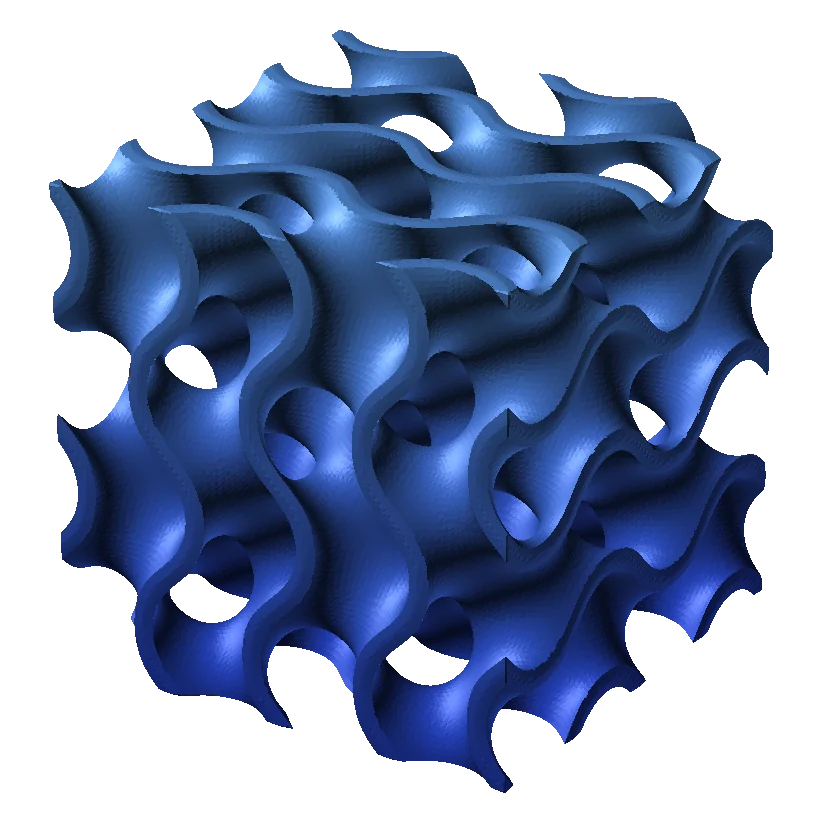 Gyroid
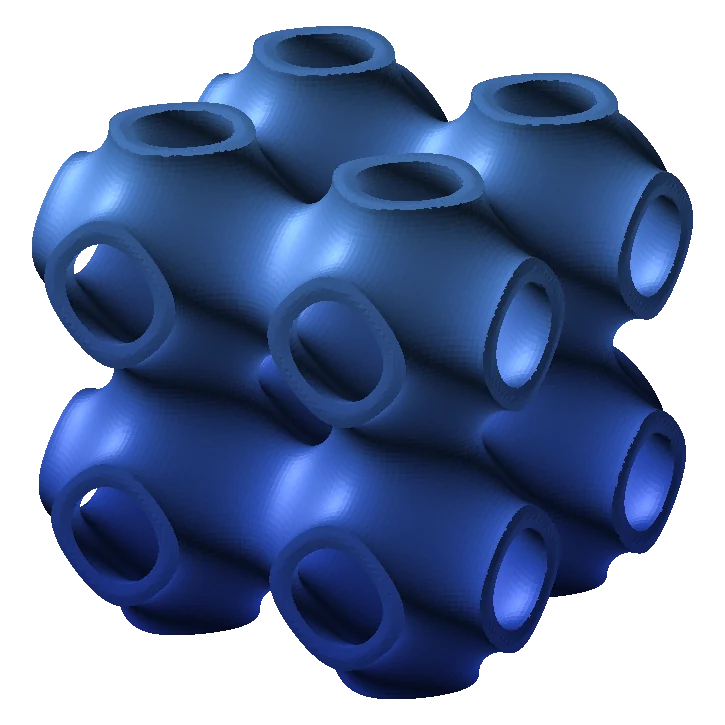 Schwarz-P
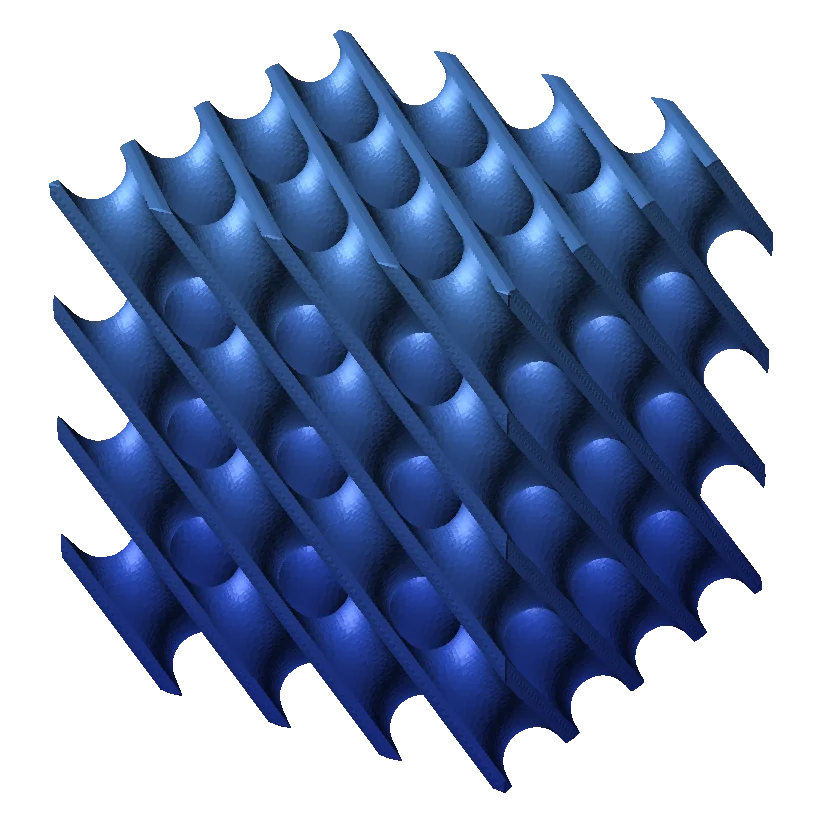 Diamond
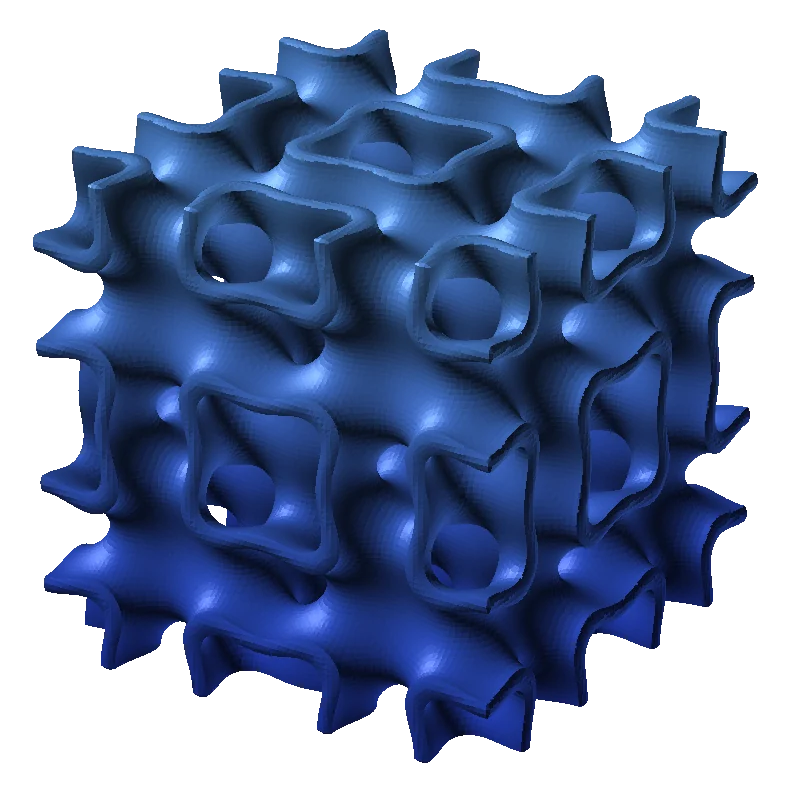 I-WP
I-WP- Triply periodic minimal surface (TPMS) lattices such as gyroid, Schwarz-P and diamond, including graded variants.
- Helmholtz resonator arrays and micro-perforated panels.
- Acoustic metamaterial unit cells and labyrinthine absorbers.
- Other 3D-printable panels and periodic porous structures supplied as CAD.
Why simulate before printing
- No print, no shipping, no lab queue. A physical test of a lattice sample typically means printing to the tube diameter, shipping and waiting for a laboratory slot.
- The geometry as designed. Print defects such as rough surfaces, trapped powder or resin, and dimensional tolerance can blur the effect of a design change. The simulation isolates the design itself.
- Many variants. Parametric families such as cell size, wall thickness, grading or air-gap depth can be compared side by side. In a 10-design pack, each one costs $139.
How absorption arises in these structures
In lattices and perforated structures, sound energy is dissipated mainly by viscous and thermal losses in narrow channels, and absorption peaks appear at resonances set by the geometry and by any air cavity behind the sample. Increasing the air gap behind a sample shifts the main absorption peak to lower frequency. Our published comparison case shows this shift for 5, 10 and 15 mm gaps.
As-designed versus as-printed
Printed parts never match the CAD exactly. If you want to know how sensitive your design is to manufacturing tolerance, we can run an as-printed tolerance study as a custom project.
Accepted files and required inputs
- Geometry: STL, STEP, IGES, 3MF, OBJ, or a ZIP of these. Up to 95 MB per file and 10 files per request.
- Either the full sample as it would sit in the tube, or one periodic unit cell plus the sample thickness and diameter.
- Units of the CAD file (for example millimetres), so the geometry is scaled correctly.
- Backing condition: rigid backing, or the depth of any air gap behind the sample.
- Tube diameter and frequency range: Ø29 mm (about 500–6300 Hz), Ø100 mm (about 50–1600 Hz), or both stitched into one curve.
- Whether you also need transmission loss.
Pricing
- $190 per design for absorption, impedance and reflection in one tube diameter.
- Design packs: 5 designs for $790 ($158 each) or 10 designs for $1,390 ($139 each).
- Add-ons: full band (both tube diameters) +$90 per design; transmission loss +$90 per design; results within 24 h +50%. Universities and public research institutes receive 20% off.
- Custom design studies, such as optimisation for a target band, are quoted per project.
- You pay by PayPal (card accepted) only after we confirm your files can be simulated. Prices in USD, excluding any applicable taxes.
Not covered
Foams and fibrous materials with no geometry file cannot be simulated this way, because their microstructure is not available as CAD. Random-incidence absorption (ISO 354 reverberation room) is also outside the scope of an impedance-tube simulation.
Background and further reading
Selected peer-reviewed studies. Summaries are our own one-line paraphrases of each paper's abstract.
Reviews
- Li, X., Jun, W.-C., Yu, X., Li, Z., Zhao, M., Wang, Z., & Zhai, W. (2023). 3D-printed lattice structures for sound absorption: Current progress, mechanisms and models, structural–property relationships, and future outlook. Advanced Science. doi:10.1002/advs.202305232
Reviews the absorption mechanisms of printed lattices and identifies morphology, relative density, cell size and number of cells as the features that most control how sound is dissipated. - Sekar, V., Cantwell, W. J., Liao, K., Berton, B., Jacquart, P.-M., & Abu Al-Rub, R. K. (2024). Additively manufactured metamaterials for acoustic absorption: a review. Virtual and Physical Prototyping. doi:10.1080/17452759.2024.2435562
Classifies additively manufactured absorbing metamaterials as perforated, slotted, cellular and hybrid, and reviews how key design parameters change their absorption.
Experimental studies on TPMS absorbers
- Yang, W.-J., An, J., Chee, K.-C., & Zhou, K. (2020). Acoustic absorptions of multifunctional polymeric cellular structures based on triply periodic minimal surfaces fabricated by stereolithography. Virtual and Physical Prototyping, 15, 242–249. doi:10.1080/17452759.2020.1740747
Tested printed Primitive, Gyroid and Diamond structures in a two-microphone impedance tube (2–6 kHz): Diamond absorbed best over a wide band in their comparison, higher volume fraction or smaller cells raised absorption, and sample height shifted the effective frequency range. - Zhang, M.-K., Liu, C., Deng, M., Li, Y., Li, J.-W., & Wang, D. (2023). Graded minimal surface structures with high specific strength for broadband sound absorption produced by laser powder bed fusion. Coatings, 13, 1950. doi:10.3390/coatings13111950
In metal gyroid lattices, absorption rose with sample height and wall offset and with smaller cells, the peak moved to lower frequency as height increased, and reversing the porosity grading traded average absorption for bandwidth.
Recent work
- Giorleo, L., Basu, S., & Piana, E. (2025). Acoustic performances of triply periodic minimal surfaces fabricated by additive manufacturing: Effects of cell geometry, aspect ratio, and wall thickness. Additive Manufacturing. doi:10.1016/j.addma.2025.104835
- Guan, X., Deckers, E., Dong, H., Hornikx, M., & Yang, J. (2025). Optimization of graded porous acoustic absorbers based on triply periodic minimal surfaces. Materials & Design. doi:10.1016/j.matdes.2025.113852
Simulation, not accredited testing. Results are a numerical simulation of the standard test configuration, not an accredited laboratory measurement. If you need a certified test report for product certification or building-code compliance, use the simulation to choose the design and then have the final design measured by an accredited laboratory.